Custom Takeaway Packaging UK is easier to buy well when the brief starts with the meal, not with a colour. A carton that looks tidy on a desk can struggle at a busy pass if the portion does not fit, the sauce has nowhere to go, or the pack was never intended for that food. This guide is for takeaway shops, restaurants, cafés and other food businesses that want a clear way to compare options and brief a supplier.
Axis Packaging supplies printed packaging for food businesses across the UK. Whether a format is suitable still depends on the food, the intended use and the specification confirmed on your quotation. Nothing here is a food-safety approval, a microwave approval, or a promise that a pack is leakproof, recyclable or compostable. Those points have to be confirmed for the exact product you are considering.
The nine tips below cover the food itself, container dimensions, food-contact suitability, leak resistance, temperature, branding, materials, order quantity, and the budget questions worth asking before you commit. Drinks have their own practical guide in cup design packing. Bakery presentation is covered in bakery and cake boxes. If the customer carries the meal in a bag, see paper bags for retail and takeaway rather than treating the bag as an afterthought in this food-pack brief.
Match the pack to the service
A pack has to hold the portion from the pass to the customer and still look right when it is opened. A filled roll, a burger, a noodle bowl and a pizza do not share one ideal pack, even from the same counter. Describe the handover, including whether the meal is bagged, and include the messy dishes in the quotation.
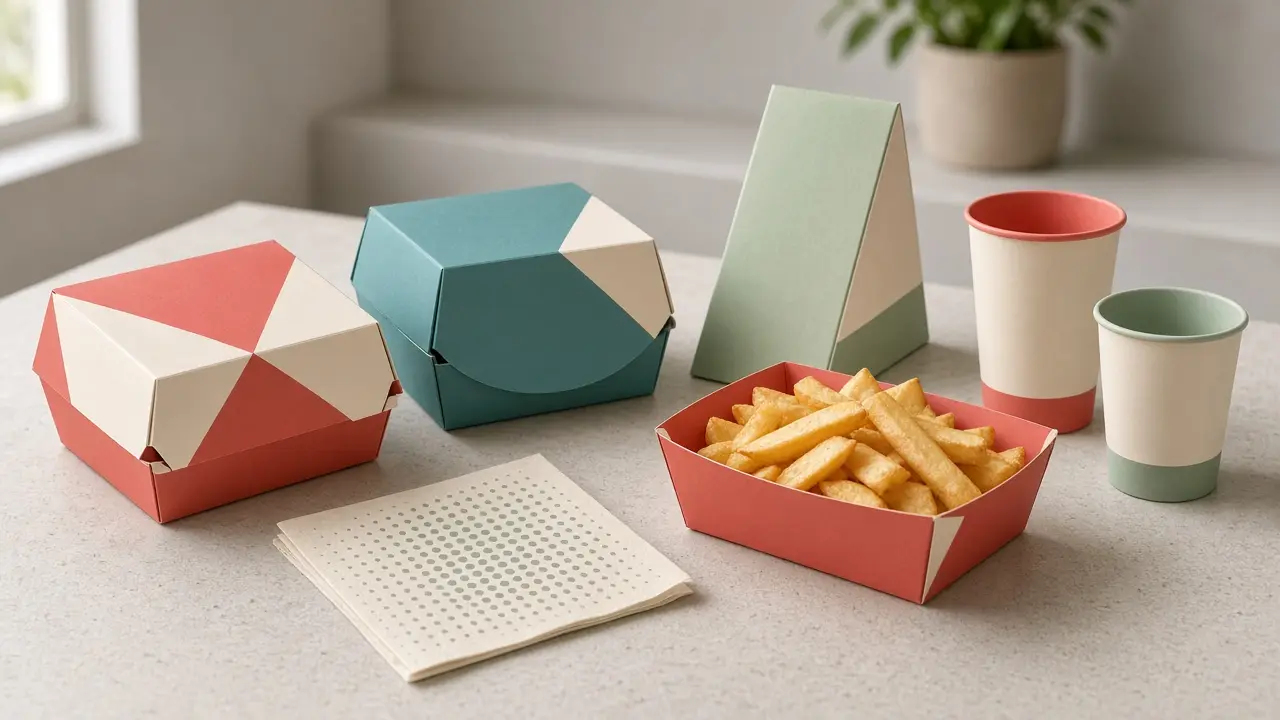
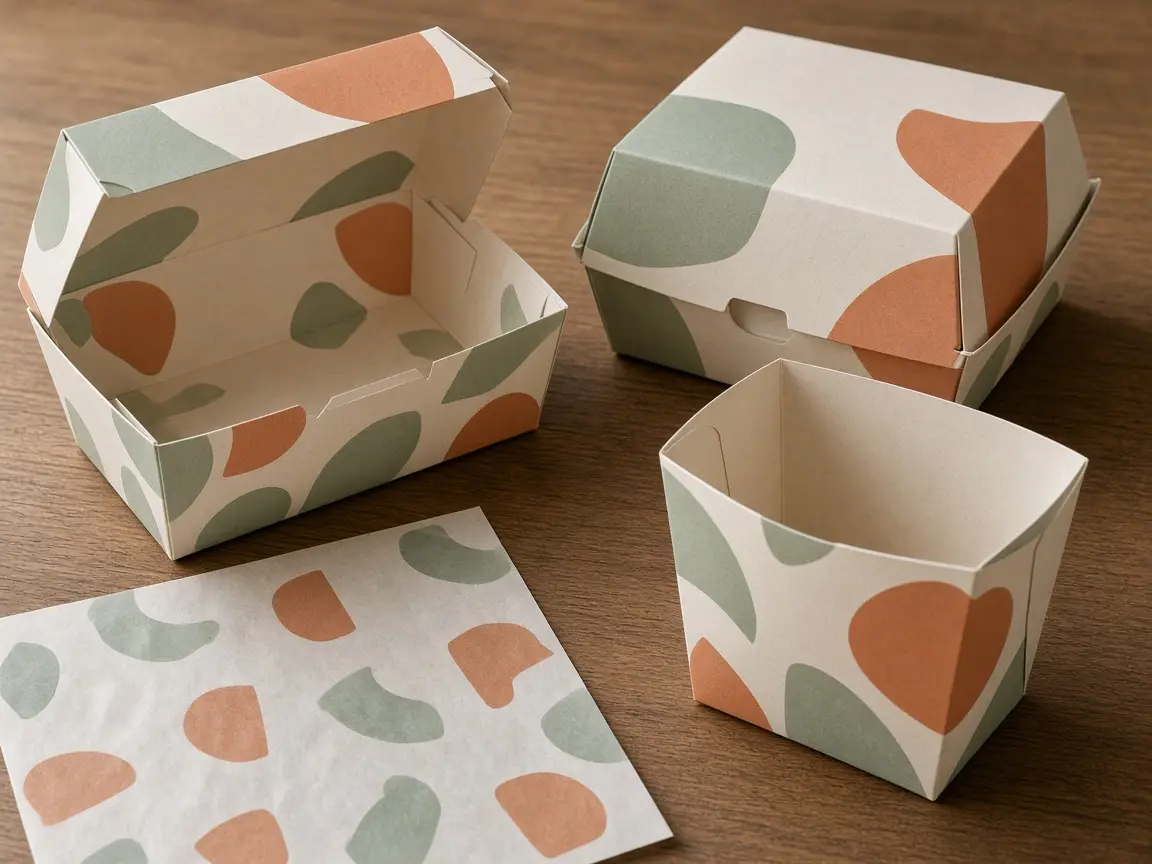
The pictures in this article illustrate the kinds of formats discussed. They are not photographs of Axis Packaging stock, and the patterns are not a print proof. Use them to think about shape, closure and what the customer sees. Use the quotation to confirm the actual board, size and print.
Custom Takeaway Packaging UK: nine buying tips
1. Name the food before you name the box
List the dishes that will share a pack, and mark the one with the most oil, steam or sauce. A format that suits chips can be a weak choice for curry, and a sandwich carton is a poor guess for a pizza. If several menu lines must share one pack, say so.
2. Measure the portion, then ask for internal dimensions
Measure the portion as you serve it, including burger height, bread length or pizza size. Ask for internal length, width and height, because the outside of a carton is larger than the space the food gets. Leave room for the lid to close. Too much empty space lets food slide. Do not assume two suppliers mean the same thing by regular or large.
3. Confirm food-contact suitability for your use
Food-contact suitability is a buying question, not a slogan on a product photo. GOV.UK food labelling and packaging guidance says that if you package food yourself, you must use packaging that is suitable for food use. It describes suitable packaging as material marked for food contact, or marked with a symbol like a wine glass and a fork. The same guidance says plastics, ceramics and cellophane have further rules, and that you need written evidence, called a declaration of compliance, which you can request from your packaging supplier.
That declaration point is about plastics, ceramics and cellophane. Do not assume a paperboard carton follows the same rule, or that it suits every dish. The Food Standards Agency publishes an overview of food contact materials regulations on GOV.UK. Reading either page is not a certificate for an Axis Packaging product. State the food and the use, and ask which information applies to that product.
4. Treat leaks as a property of the meal
Leak resistance depends on the food, the way the pack closes, how long it is carried, and whether a liner is part of the specification. A carton can look sturdy and still mark a bag when the dish is oily or very saucy. Describe your wettest item and a typical holding time. Ask whether the quoted pack is intended for that use, and what would need to change if it is not.
5. Say whether the food is hot, cold or reheated
Say whether the food is packed hot, warm or chilled, and how long it usually travels. Steam from a hot pass can soften a lid or leave a carton damp. A chilled sandwich is a different job from a pizza, so do not assume one board suits both.
Do not print a microwave or oven instruction unless it has been confirmed for that product. Many cartons are specified for packing and carrying, not reheating. Pizza boxes, burger boxes and noodle boxes are familiar formats, but they are not interchangeable. Match the shape to the portion.
6. Brand the panel the customer actually sees
Branding should help someone recognise the shop and tell one meal from another at a glance. A clear name, a simple mark and a short description of the contents are usually more useful than covering every face with small type. Ask which panel faces outward at the pass and in a bag, and put the important print there. Keep fine detail off folds and off areas that sit against greasy food. A printed menu is separate from the food pack. Restaurant menu cards are that printed piece, not the carton.
7. Choose the material for the food, then ask what it includes
Material choice is the format plus anything lined, coated or added to it. Printed food trays are a practical starting point for chips, sides and other open portions. Sandwich boxes suit wedges and longer breads when the internal length matches the bread you sell. Paper cups are for drinks. They are not a stand-in for a saucy main, and cup construction is already covered in the cup article.
Ask what the material is, whether a coating or lining is included, and which foods that specification is intended for. A plain-looking board can still be coated. Do not assume a pack is recyclable or compostable because it looks like paper. Collections, coatings and the supplier’s specification all matter. Name the material you want, and let the quotation say whether it can be supplied for that food.
8. Order a quantity you can store and sell through
Order quantity is a storage decision as well as a price decision. Packs need a clean, dry place, away from anything that could mark or dampen them. A large delivery that is crushed, stored badly, or still in the shop after a menu change is not a saving. Estimate how many of each format you use in a normal week, including the busy spells you can predict, and say whether several dishes share one pack.
A smaller first quantity can check the size in service before you order more. Axis Packaging confirms quantity on the quotation. This guide does not state a minimum order or a production time, because both depend on the format and the print. If trade is seasonal, say so.
9. Compare the budget against the same brief
Budget comparisons only work when the quotations describe the same internal size, material, print and quantity. A lower price for a smaller carton, fewer colours or no lid is a different offer. Ask what is included and which changes would move the price, such as a lid, another colour, a different board or a different quantity. This article does not quote a price. The figure belongs on your quotation.
Before you approve print, ask which foods the specification is intended for, what the internal dimensions are, whether a lining is included, and whether reheating is an intended use. If you also post dry goods, mailer boxes are for dispatch. They are not a substitute for hot food unless that use is confirmed.
Compare common formats before you choose
Use the table as a shortlist, not as a performance rating. “Often used for” describes a typical brief. It is not a guarantee that the format suits your recipe, your holding time or the way you ask customers to dispose of the pack. Confirm the last column on the quotation.
| Format | Often used for | Confirm before you order |
|---|---|---|
| Printed food trays | Chips, sides and other open portions | Internal size, and whether a lid is part of the quote |
| Pizza boxes | Whole pizzas | Base size against your pizza, and how the box closes |
| Burger boxes | Burgers and similar filled handheld meals | Height of the burger as you serve it, including extras |
| Noodle boxes | Noodles and other bowl-style dishes | Portion size, and whether you need a handle |
| Sandwich boxes | Sandwiches, baguettes and similar breads | Wedge or rectangular shape, and the bread length |
| Greaseproof paper | Wrapping or lining selected foods | Sheet or roll, and the foods you will wrap |
| Paper cups | Hot and cold drinks | Drink size, and whether a lid is included |
A checklist to send with your enquiry
Work through this list before you request a quote. You do not need a perfect specification. You do need enough detail for two quotations to describe the same job.
- The menu items that will share each pack, with the messiest item marked
- Whether the food is packed hot, warm or cold, and how long it is usually carried
- The internal length, width and height you need, taken from the portion you serve
- Whether a lid, liner, insert or handle is required
- The food-contact information you need confirmed for that product and use
- Where the print should sit, how many colours you want, and any wording you will not put on the pack
- The quantity you can store cleanly, and whether you want a smaller first quantity to test in service
- What must stay the same if you compare two quotations: size, material, print and quantity
Read the answers against the food
Check replies against the meal, not only the lowest figure. If the foods or the internal dimensions are missing, the brief is not finished. Write down any difference in size, material, lid and quantity before you decide, so a later order can match the pack that worked.
Request a quote from a written brief
With the food, the size and the supplier’s answers written down, quotations are easier to compare and later orders can match the pack that worked. Send the food, the pack style, the print and the quantity you can store to Axis Packaging, and ask for a custom packaging quote. We will confirm what can be supplied. Request a custom packaging quote.